

Dialectics Simplified
The Business of Dialectics

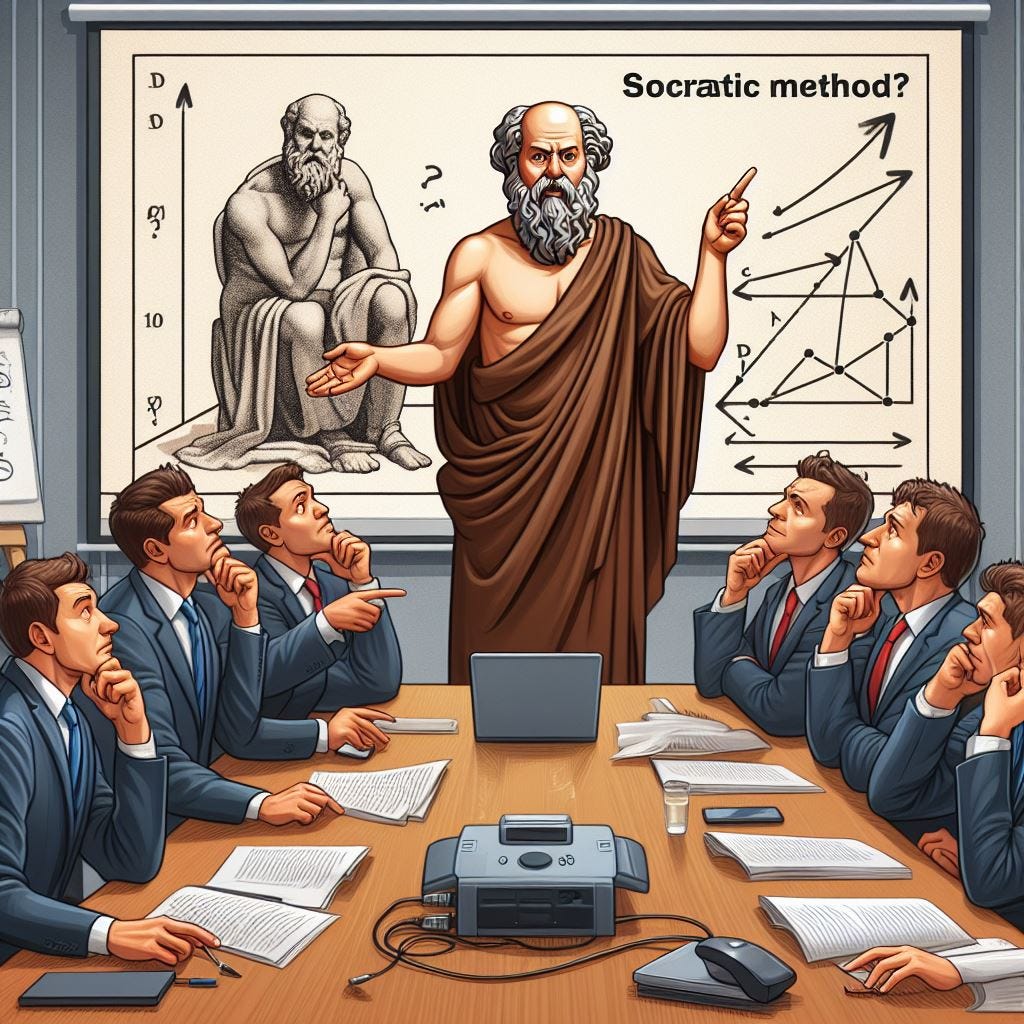
This Blog has three goals:
To learn more about the nature of propaganda and deception.
To articulate my own partially formed intuitions.
To learn how to articulate ideas in an extremely readable and engaging way.
So far I've focused on the second goal. Here I want to focus readability and engagement.
More and more the word 'dialectic' is making its way out of the heady realm of academia and into that of popular speech. Yet, the more I hear of it the more I hear it misused.
I've found a definition on Wikipedia which is fundamentally correct. In this post I'll go into how it is correct. In the next I'll go into how it isn't.
Dialectic, also known as the dialectical method, refers originally to dialogue between people holding different points of view about a subject but wishing to arrive at the truth through reasoned argumentation. Dialectic resembles debate, but the concept excludes subjective elements such as emotional appeal and rhetoric.
I consider this definition to be quite good. I particularly like that this definition distinguishes dialectic from debate. Dialectic is cooperative, debate is competitive. In debate there are winners and losers. Dialectic makes everyone a winner.
In previous posts I have tried to explain the dialectical process by what it isn't—that it isn't rhetoric. But it strikes me that the best way to explain it is to compare it to modern business-speak. To put it in terms of conflict resolution and project management. 'Dialectic' is very much like conflict resolution. The aims of dialectic are more grand, but it's methods are essentially the same.
Conflict resolution aims at incorporating the conflicting interests of stakeholders into a resolution which would make project management easy. Rather than conflicts of interest, dialectic aims at resolving intellectual conflicts. Conflict resolution involves negotiation the desires of stake holders in order to create a resolution where everyone is, if not happy, at least satisfied. With conflicts resolved stakeholders can then proceed to cooperative project construction. Dialectic is similar, but instead of 'stakeholders' we call them 'interlocutors'. Stakeholders include anyone who has a stake in a proposed project. Interlocutors include anyone involved in a particular discussion.
Instead of negotiating between 'interests' dialectic negotiates between 'opinions' or 'beliefs'. Conflict resolution seeks a 'resolution'. In dialectics we would call these resolutions 'definitions'. Whereas conflict resolution aims to align stakeholder interests in order to create 'buy-in' for a given project, dialectic aims at aligning 'opinions' so that definitions can be formed. When definitions are achieved interlocutors can then go onto a more structured and productive discussion called a 'discourse.' A 'discourse' is merely an intellectual project.
So, to summarize:
Opinions = interests
Definition = resolution
Interlocutor = stakeholder
Discourse = project
Perhaps the biggest difference between conflict resolution and dialectics is found in the concept of 'buy-in'. The dialectical equivalent could simply be thought of as 'agreement'. But more properly, for dialectics 'buy-in' is 'truth'. This is because we don't want our intellectual projects to merely be built on a shared delusion. Just because we can all agree that something, that doesn't necessarily make it correct.
Dialectic has the strictest possible standard of 'buy-in'. It’s goal is not to be unduly influenced by any one stakeholder (interlocutor), or any group of stakeholders. Instead its goal is to be 'persuaded by the truth'. This grand standard is what separates the study of philosophy from the mundane practice of conflict resolution and project management. This one standard is what takes dialectics out of the realm of the extremely practical and mundane business world into the extremely impractical and ethereal realm of philosophy.
'Debate' is not the same as 'dialectic'. Keeping with the business analogy, debate is more like contract competition. There certainly isn't anything wrong with debate. Philosophical debate often helps clarify ideas. But it's competitive nature isn't compatible with the cooperative spirit of dialectic. Much like how two building contractors can submit competing bids, debate is a contest of ideas. Like contract competition, debate requires the use of rhetoric and persuasion. Keeping with the analogy, rhetors are simply intellectual salesmen.
There is nothing necessarily wrong with rhetoric and persuasion, just as there is nothing wrong with competition. In fact competition is necessary. We don't have all of eternity to discuss the nature of truth. Choosing between competing options is the bulk of what humans do. But when we must choose between who wins and who loses rhetoric can be dangerous. A skilled rhetor can easily convince us to choose wrongly.